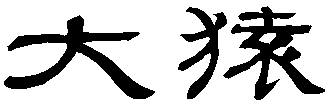
Quite often I am asked if there is any meaning to my website address www.ozaru.net, or why I used the name "Ben 'Ozaru' Jones" when translating Sanmyaku, the Bujinkan Dojo journal. Well, although Ozaru could mean "Big Sieve" (as one New Yorker noticed, in some confusion), and is also a technical term used in Igo, in my case it means "Big Ape" and is written as 大猿.
Martial artists all over the world seem to have used aliases or nicknames for a long time. In Japan they are called Bugo (similar to the Yago of Kabuki performers or the Go of visual artists), and in France and various other countries, Noms de guerre (similar to the Noms de plume of authors); I don't know the Chinese term, but I'm sure there is one -- look at the cast of any Hong Kong Kung Fu film. It is not certain how such customs arose ... if any anthropologists, sociologists, or psychologists etc. read this, I'd be interested to hear your theories!
In the Bujinkan Dojo too there is a tradition of having Bugo -- the current head of the school, Dr Masaaki Hatsumi, has been through around a dozen different names (e.g. Tetsuzan, Hisamune), and his teacher, Toshitsugu Takamatsu also had a large number (although some of them he only used in painting etc., i.e. they were his noms de plume rather than noms de guerre). I asked Dr Hatsumi about Bugo once, and he said that he had given the character Ryu (dragon) to some of his students when they became Shidoshi. Some also seemed to receive the character Ko (tiger), so you can see examples such as Ninryu, Kotetsu, Moko, and even Ryuko.
I thought over what name I would like when I became Shidoshi, and hit upon Ozaru for various reasons. Firstly, when surrounded by skillful, short Japanese people in the Dojo I felt like a big ape. I also felt a profound empathy with gorillas (being vegetarian yet reasonably strong), and aspired to emulate their playful naturalness. In addition, I knew there was a famous Ninja character called Sarutobi Sasuke, whose father was Ozaru, and I felt that if Dragon and Tiger were good names, Big Ape might be too. I therefore asked Dr Hatsumi, and he agreed that I could use the name -- even pointing out that a previous grandmaster of one of the schools we study had also been called Ozaru. (It was only much later that I discovered there are also Japanese tales about legendary "giant apes" who got drunk and terrorized country villages. Later still I realized that the popular manga DragonBall also features giant primates known as Oozaru.)
What does my name mean to me? How is it to be used? Well, to be honest, I'm still not sure. In one sense, I took the name in the hope that it would help me understand Bugo in general. There are similarities with the way that grades are awarded in the Bujinkan. In modern "martial sports", grades appear to be "rewards", either for good training or for contributions to the art in other ways. Practitioners of traditional martial arts in Japan on the other hand were often awarded a grade when very young, or total beginners -- even something like "grandmaster"! The point of this "Sakizuke" system was that they would consider it an obligation or incentive, and strive to live up to the grade and discover its worth for themselves. Maybe I'll realize the meaning of Ozaru when I decide it's time to change it and move on.
So now you know ...